
If you’re searching for clear, up-to-date insights on the latest shifts in gaming—whether that’s competitive hunt strategies, inner core raid mechanics, or Bold on cloud gaming advancements—you’re in the right place. The gaming landscape is evolving fast, and staying ahead means understanding not just what’s new, but how it impacts your gameplay and performance.
This article breaks down the most important developments shaping today’s meta, from optimized gear builds to advanced raid coordination tactics. Instead of surface-level updates, you’ll get practical analysis designed to help you make smarter in-game decisions and elevate your results immediately.
Our coverage is built on hands-on gameplay testing, detailed mechanic breakdowns, and continuous monitoring of emerging trends across the competitive scene. That means you’re getting insights grounded in real performance data—not speculation.
By the end, you’ll have a sharper understanding of current strategies, system updates, and where the next competitive edge is emerging.
The End of Downloads: How Cloud Servers are Redefining Gameplay
For years, your gaming experience was only as powerful as the box under your desk. Expensive GPUs, endless patches, and 100GB downloads were the price of admission. Now, however, remote servers render the game elsewhere and stream it to you in real time. In other words, the heavy lifting happens in data centers optimized with GPUs, NVMe storage, and edge nodes positioned closer to players.
Thanks to cloud gaming advancements, latency is reduced through adaptive bitrate streaming and predictive input modeling (the system guesses your next move milliseconds ahead). As a result, you get smoother visuals and faster response times without constant upgrades.
The benefit is simple: lower costs, instant access, and high-fidelity gameplay on almost any device. So instead of managing hardware, you just play.
Under the Hood: The Architecture of a Modern Gaming Cloud
From data center to display, a modern gaming cloud works like a high-speed relay race. When you press a button, that input is transmitted to a remote server, often within milliseconds. The server processes the game logic, renders the frame on a powerful GPU, encodes it into video, and streams it back to your screen.
Back in 2019, latency spikes were common, but after years of optimization, the pipeline is TUNED for speed. The server stack has evolved too. Early platforms relied on generic virtual machines. Today, providers deploy custom blades packed with CPUs designed for low-latency scheduling and GPUs like NVIDIA’s L40S built for parallel rendering. This shift, accelerated during the cloud gaming advancements surge of 2020, reduced jitter and improved frame consistency.
Then there is the edge. By placing micro data centers near population hubs, companies shorten physical distance, which directly cuts latency. Think of it as moving the stage closer to the audience instead of shouting across a canyon. Can fiber outrun physics? Not entirely, but edge networks are the FIRST LINE OF DEFENSE against lag, keeping gameplay responsive and competitive. Even under peak evening traffic loads.
Slaying the Latency Dragon: Innovations in Speed and Responsiveness
Latency is the invisible dragon every remote player must slay.
First, let’s define the two main villains. Input lag is the delay between pressing a button and seeing the action happen on screen. Network latency (often called “ping”) is the time it takes for data to travel from your device to a server and back. In an FPS, input lag throws off your crosshair placement. In high-stakes raid mechanics, network latency can mean dodging a boss slam a split-second too late (and yes, your team will notice).
Here’s the upside: modern tech is fighting back HARD.
AI-powered predictive algorithms now anticipate player actions before inputs fully register. By rendering frames ahead of time, systems mask delay so gameplay feels immediate. The benefit? Smoother aim tracking, tighter parry windows, and fewer “I definitely dodged that” moments.
Then there’s NVIDIA Reflex, a latency-reduction technology that synchronizes CPU and GPU workloads to shrink the rendering queue. Less internal pipeline delay means faster on-screen feedback. For competitive players, that translates into measurable reaction-time gains (NVIDIA reports latency reductions of up to 50% in supported titles).
Finally, optimized UDP-based network protocols ditch slower, reliability-first standards in favor of real-time responsiveness. Combined with cloud gaming advancements, these protocols prioritize speed over perfection—because in games, timing beats tidiness.
The result? Sharper control, cleaner execution, and PERFORMANCE that feels instant—not almost.
Pixel Perfect: The Evolution of Video Compression and Quality
More Than Just a Video
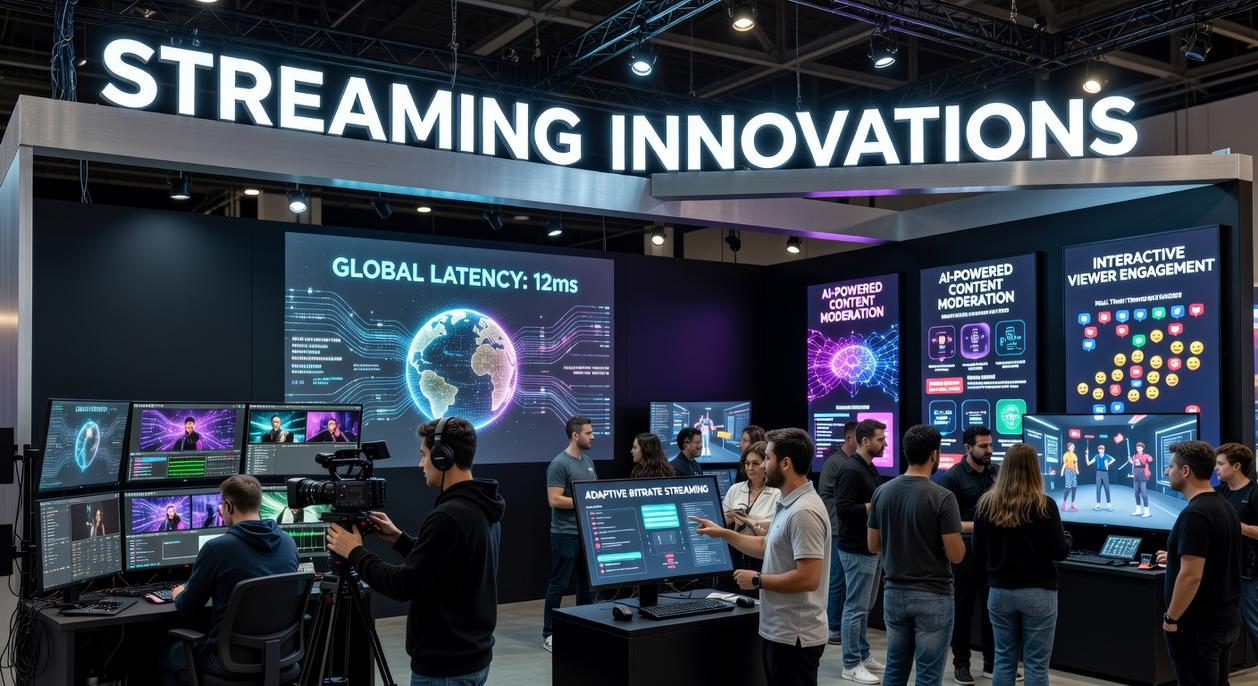
Game streaming isn’t just Netflix with a controller. A movie runs at a steady frame rate with predictable scene transitions. A game? It can jump from a dim dungeon to a particle-filled boss fight in milliseconds. That volatility—rapid scene changes, variable frame rates, and user-driven camera movement—creates massive compression strain. Every button press reshapes the next frame. (Your GPU doesn’t get a coffee break.)
Some argue that if movies stream fine, games should too. But films are pre-encoded. Game streams are rendered live, encoded in real time, and sent across unstable networks. That difference is everything.
The AV1 Codec Revolution
AV1, a next-generation video codec (a compression standard that reduces file size while preserving quality), delivers higher visual fidelity at lower bitrates than H.264 and even H.265 (Alliance for Open Media, 2023). In practical terms: sharper textures, fewer blocky shadows, and cleaner motion—without demanding more bandwidth. Competitors talk about “better compression,” but the real edge is efficiency under stress. AV1 handles chaotic frames—think explosive PvP arenas—without smearing detail.
Dynamic Bitrate Adjustment
Modern platforms use adaptive bitrate streaming, meaning quality shifts in real time based on your connection. If bandwidth dips, resolution scales smoothly instead of freezing. It’s invisible when done right (and painfully obvious when it’s not).
HDR and High Refresh Rates
High Dynamic Range (HDR) expands contrast and color depth, while 120+ FPS streaming reduces motion blur and input latency. Combined with cloud gaming advancements, server-side rendering now rivals high-end local PCs. That’s not hype—it’s measurable latency reduction and luminance expansion (ITU-R BT.2100 standard).
For competitive players tracking esports rule changes you need to know this season, visual clarity isn’t cosmetic—it’s tactical.
The Horizon: What’s Next for Cloud-Native Gaming
Cloud-native gaming means titles built to run on remote servers instead of your console. Think city-scale physics simulations or AI-driven NPCs that evolve daily—features powered by cloud gaming advancements rather than local hardware.
Cloud-Exclusive Experiences
Studios are designing worlds that rely on massive server-side processing for real-time destruction, weather, and AI ecosystems. To prepare, prioritize:
| Feature | What to Check | Why It Matters |
|---|---|---|
| Latency | Under 20ms |
Smoother combat |
| Bandwidth | 25+ Mbps | Stable 4K play |
| 5G Access | Strong signal | Mobile viability |
Seamless Integration & 5G
Start on TV, switch to phone mid-commute, finish on laptop—no installs. Test this now: log into one platform account across devices and measure sync speed. If 5G coverage is strong in your area, experiment with mobile-first sessions. (Yes, even ranked matches.)
Optimizing Your Jump into the Cloud
We’ve covered how cloud gaming advancements in server hardware, edge networks, and video encoding have transformed remote play. According to Newzoo, 40% of gamers have tried a streaming platform, citing performance parity with consoles. The unlock is access: high-end GPUs now live in data centers, not your living room.
Before subscribing, focus on the variable you control: your connection.
- Test latency (ping) to a nearby server using tools.
- Aim for under 30ms for competitive titles.
- Use a wired Ethernet line for stability.
Stable bandwidth beats flashy specs every time.
Pro tip: reboot your router
Level Up Your Edge in the Evolving Hunt
You came here to sharpen your understanding of today’s evolving hunt meta—and now you have the clarity to move with confidence. From advanced raid mechanics to pro gear optimization and the impact of cloud gaming advancements, you’re no longer guessing your way through encounters. You understand what’s changing, why it matters, and how to adapt.
The real pain point isn’t difficulty—it’s falling behind. In competitive hunts and inner core raids, hesitation and outdated strategies cost clears, loot, and rank. When mechanics shift and optimization standards rise, staying static means slipping down the ladder.
Now it’s time to act. Apply these strategies in your next run. Refine your loadout. Break down your last raid and adjust based on the mechanics you’ve learned. If you’re serious about dominating high-level hunts, keep leveling up with the #1 rated source for emerging gaming insights and elite strategy breakdowns.
Don’t let the meta outpace you. Dive deeper, optimize smarter, and start winning more hunts today.