

If you’re searching for a competitive edge in today’s toughest hunts and inner core raids, you’re in the right place. This article breaks down the latest emerging gaming updates, lifted gameplay fundamentals, advanced hunt strategy breakdowns, and the raid mechanics that are wiping unprepared squads. Whether you’re pushing endgame content or refining your rotations, you’ll find clear, actionable guidance designed to improve performance immediately.
We’ve analyzed patch notes, high-tier player runs, and evolving meta shifts to ensure the insights here reflect what’s actually working right now—not outdated forum theory. From pro gear optimization tips to keyboard input optimization techniques that tighten execution under pressure, every section is built around practical application.
By the end, you’ll understand the mechanics that matter, the strategies that scale, and the optimizations that separate consistent clears from constant retries. Let’s sharpen your approach and elevate your gameplay where it counts most.
Every millisecond counts in competitive play. The gap between a clutch win and a frustrating defeat often comes down to unseen delay. Before blaming mechanics, check your pipeline: operating system settings, firmware, switch actuation, and polling rate.
Start with keyboard input optimization by disabling unnecessary background apps, turning off OS key filtering, and updating drivers. Next, test hardware latency with reputable tools like RTINGS benchmarks (RTINGS.com).
Pro tip: lower debounce time cautiously; too low can cause chatter.
Focus on:
- Consistent actuation force
- Stable polling rates
- Practiced, intentional keystrokes
When your board feels invisible, your APM finally shows.
Digital Tuning: Software and Driver-Level Optimizations
To enhance your typing experience and speed, optimizing your keyboard settings can make a significant difference, much like the recent innovations highlighted in our article on Hssgamestick Updates By Hearthstats.
Before you swap switches or buy a new board, start with what’s already humming beneath your fingertips: your operating system. In Windows, open Keyboard Properties and max out the Character repeat rate while shortening the Repeat delay. The difference feels immediate—letters snap onto the screen the instant you press, like a drumroll tightening into perfect tempo. Just as importantly, make sure Filter Keys is disabled; otherwise, the OS may quietly ignore rapid taps (and nothing stings like a missed dodge because your PC hesitated).
Next, move down the stack.
-
Update Drivers and Firmware
Install the latest manufacturer software—Razer Synapse, Corsair iCUE, or your board’s equivalent—and check for firmware updates. These often include latency refinements and stability patches. Think of it as sharpening a blade; you may not see the edge change, but you’ll feel it slice cleaner. -
Lower Debounce Time
Debounce time is the delay a keyboard uses to prevent accidental double inputs. Many gaming keyboards let you reduce it (for example, from 8ms to 1ms). The result? Rapid-fire abilities trigger with a crisp, staccato precision that sounds almost mechanical in your headset. -
Engage Game Mode and Trim Background Noise
Activate your OS’s Game Mode and close unnecessary background apps. Fewer CPU interruptions mean smoother input, fewer micro-stutters, and a steadier on-screen rhythm.
Altogether, this is keyboard input optimization at its most tactile—where every press feels sharp, immediate, and undeniably alive.
The Physical Edge: Hardware Modifications for Peak Performance
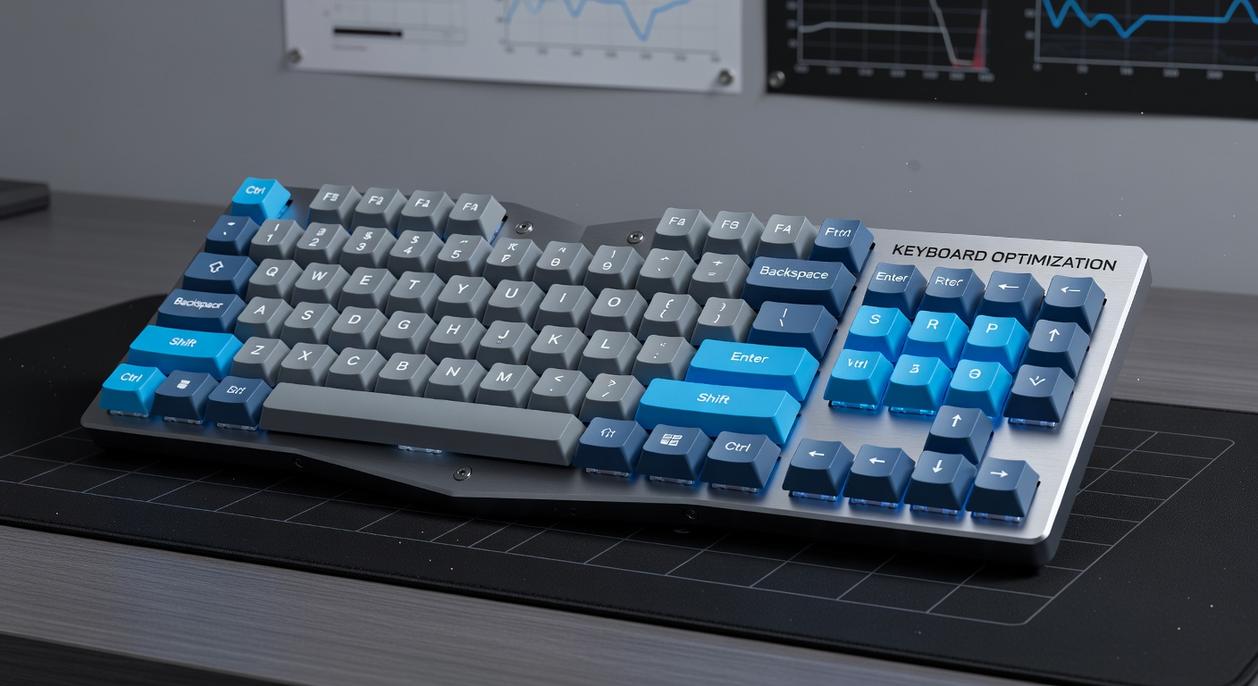
Have you ever wondered why two players with identical specs perform differently under pressure? The answer often comes down to hardware feel.
Linear switches—a type of mechanical key switch with smooth, uninterrupted travel—like Cherry MX Red or Speed Silver are considered the competitive standard. With low actuation force (the amount of pressure needed to register a keypress), they allow faster repeated inputs without a tactile bump slowing you down. That uninterrupted glide matters when milliseconds decide fights (think esports finals, not casual queue night). Some players argue tactile switches improve accuracy because of physical feedback. Fair point. But in high-speed scenarios, reduced resistance often wins out. Optical switches go further, using light-based actuation instead of metal contact, reducing debounce delay and pushing response times even lower (manufacturers like Razer and SteelSeries cite faster actuation through optical tech).
Then there’s the custom keyboard advantage. A solid aluminum case minimizes flex, high-quality stabilizers reduce key wobble, and hot-swappable sockets let you test switches without soldering. Stock boards can work fine—some pros use them—but customs offer consistency you can tune to your exact preferences. Why settle for generic when precision is available?
Physical mods elevate things further. Lubing switches and stabilizers reduces friction, creating smoother keystrokes and faster return. O-rings shorten travel distance, helping aggressive bottom-out players react quicker. Is it necessary? Not always. But when optimizing keyboard input optimization, marginal gains stack up.
Pro tip: test one modification at a time so you can feel measurable differences.
• CAPS
•
•
Mastering the Human Element: Technique and Ergonomics
A few years ago, I lost a ranked match I should’ve won. Not because of strategy—but because I fumbled a cooldown while glancing at my keyboard. That moment sold me on touch-typing. When you know every key by feel (a skill called muscle memory, meaning automatic movement without conscious thought), your brain is free to track minimaps, timers, and enemy tells. For MMO and RTS players especially, that’s the foundation of real keyboard input optimization.
Some argue that “good mechanics beat typing drills.” Fair—but why not both? Just like athletes drill footwork, gamers benefit from repetition.
Ergonomics for Endurance
Long sessions expose bad posture fast. A neutral wrist position (wrists straight, not bent up or down) reduces strain and preserves reaction speed. I noticed fewer late-game misclicks once I adjusted my keyboard tilt.
| Factor | Poor Setup | Optimized Setup |
|---|---|---|
| Wrist Angle | Bent upward |
Neutral, flat |
| Fatigue | High after 2 hrs | Minimal after 4 hrs |
| Input Errors | Frequent | Reduced |
Research from OSHA links awkward wrist posture to repetitive strain injuries (OSHA Ergonomics Guidelines).
Targeted Drills and Practice
Typing trainers improve rhythm and accuracy—not just WPM. Then transition in-game: rehearse ability rotations or weapon swaps until they feel automatic. It’s the same logic behind monitor refresh rates explained for esports performance: small mechanical gains stack into competitive edges. (Yes, even the boring drills.)
Pro tip: Practice at 90% speed first—perfect form beats frantic mashing every time.
Deep Customization: Firmware, Polling Rates, and Macros
Serious players eventually face a choice: stock settings or total control.
Firmware: QMK/VIA vs Default Software
Stock firmware lets you remap a few keys. QMK and VIA let you rebuild the board’s brain. You can create layers (think alternate key maps), assign Tap Dance (one key, multiple actions based on taps), and fine-tune keyboard input optimization at the firmware level. It’s the difference between rearranging furniture and redesigning the house. The counterargument? It’s overkill for casual users—and yes, flashing firmware isn’t for the faint of heart (one wrong step and you’re troubleshooting at 2 a.m.).
Polling Rates: 1000Hz vs 8000Hz
1000Hz reports every 1ms. 8000Hz drops that to 0.125ms. In reality, gains above 1000Hz are marginal, but in esports, fractional milliseconds can matter.
Macros: Utility vs Abuse
• Crafting macro in an MMO? Efficient.
• Automated recoil control in ranked? Bannable.
Power is great—responsibility keeps your account intact.
Your path to millisecond supremacy starts with ruthless keyboard input optimization. I believe most players overcomplicate it—CHASING gear before fixing fundamentals. Start with free software tweaks; they deliver instant, tactile gains.
- Cut latency settings
- Disable unnecessary macros
Do this, and intent hits screen faster. THAT edge wins fights.
Master Your Hunt From the Inside Out
You came here to sharpen your edge—to understand hunt strategy breakdowns, inner core raid mechanics, and the systems that separate average players from true tacticians. Now you have the framework to read encounters faster, adapt to shifting mechanics, and execute with confidence when the pressure spikes.
The difference between wiping and winning often comes down to precision. Missed timing. Sloppy rotations. Poor keyboard input optimization. These small inefficiencies compound, costing you damage, survivability, and team momentum when it matters most.
Act now: refine your loadouts, drill the mechanics outlined above, and tighten your inputs until every action is intentional. The top-ranked hunters don’t rely on luck—they rely on optimized systems and proven strategies that consistently clear the hardest content.
If you’re ready to stop reacting and start dominating, apply these tactics in your next run and commit to mastering the fundamentals. Your next flawless clear starts with the adjustments you make today.
 There is a specific skill involved in explaining something clearly — one that is completely separate from actually knowing the subject. Veyron Mornvale has both. They has spent years working with hunt strategy breakdowns in a hands-on capacity, and an equal amount of time figuring out how to translate that experience into writing that people with different backgrounds can actually absorb and use.
Veyron tends to approach complex subjects — Hunt Strategy Breakdowns, Lifted Gameplay Fundamentals, Inner Core Raid Mechanics being good examples — by starting with what the reader already knows, then building outward from there rather than dropping them in the deep end. It sounds like a small thing. In practice it makes a significant difference in whether someone finishes the article or abandons it halfway through. They is also good at knowing when to stop — a surprisingly underrated skill. Some writers bury useful information under so many caveats and qualifications that the point disappears. Veyron knows where the point is and gets there without too many detours.
The practical effect of all this is that people who read Veyron's work tend to come away actually capable of doing something with it. Not just vaguely informed — actually capable. For a writer working in hunt strategy breakdowns, that is probably the best possible outcome, and it's the standard Veyron holds they's own work to.
There is a specific skill involved in explaining something clearly — one that is completely separate from actually knowing the subject. Veyron Mornvale has both. They has spent years working with hunt strategy breakdowns in a hands-on capacity, and an equal amount of time figuring out how to translate that experience into writing that people with different backgrounds can actually absorb and use.
Veyron tends to approach complex subjects — Hunt Strategy Breakdowns, Lifted Gameplay Fundamentals, Inner Core Raid Mechanics being good examples — by starting with what the reader already knows, then building outward from there rather than dropping them in the deep end. It sounds like a small thing. In practice it makes a significant difference in whether someone finishes the article or abandons it halfway through. They is also good at knowing when to stop — a surprisingly underrated skill. Some writers bury useful information under so many caveats and qualifications that the point disappears. Veyron knows where the point is and gets there without too many detours.
The practical effect of all this is that people who read Veyron's work tend to come away actually capable of doing something with it. Not just vaguely informed — actually capable. For a writer working in hunt strategy breakdowns, that is probably the best possible outcome, and it's the standard Veyron holds they's own work to.